
TRENDING: Millennials v Gen Z, Met Gala and algorithms
MILLENNIAL VS GEN Z
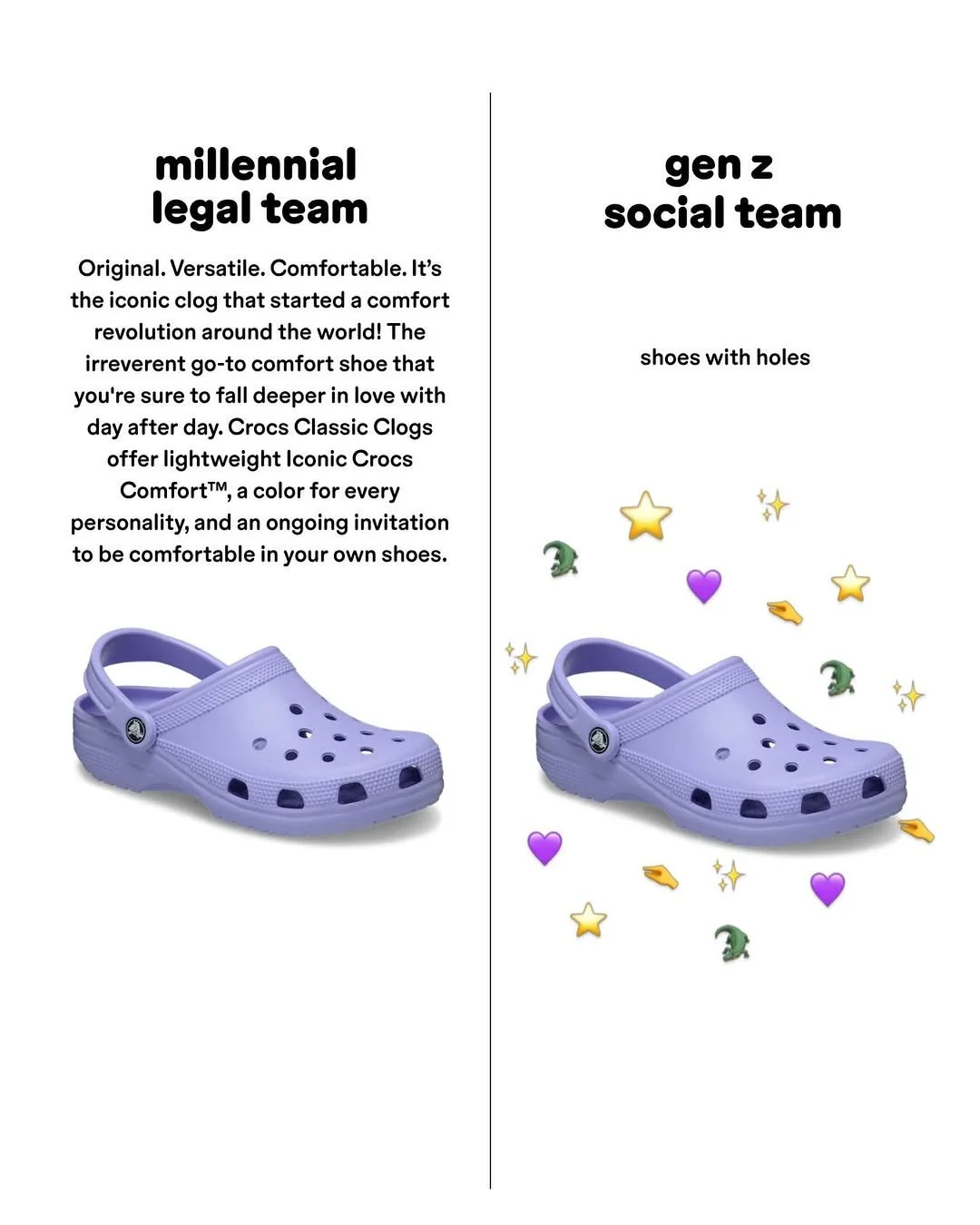
Plain white background. Black sans-serif copy. Two columns: "How a millennial markets this product" on the left, "How Gen Z markets this product" on the right. The millennial side is full of structured copy: features, benefits, polished value props, the kind of language that wins a Cannes pitch. The Gen Z side is one or two words: "yes." "girl run." "bestie it works." "It's giving." It's a meme, but it's also a tonal map for an entire industry, and brands have caught on fast: KitKat, telcos, banks, government departments and dozens of agencies have rolled their own version this fortnight, often with the energy of a dad discovering slang on TikTok.
Brand opportunities
This is one of the easiest, fastest brand-led posts of the year: no shoot, no edit, no sound, just a Canva grid and a strong sense of self. The trick is to be honestly self-aware on the millennial side (your brand probably does over-explain) and confidently brief on the Gen Z side (resist the urge to cushion or qualify). It's also a brilliant internal exercise: pull your last five social captions, and ask "if this is what we sound like to a 32-year-old, what would the 22-year-old version actually say?" Most brands will discover their entire content calendar reads as the millennial column.
MET GALA RED FLATS ASSISTANT
The single most-discussed non-celebrity from this year's Met Gala carpet was the woman in red ballet flats: a video went viral of a staffer/handler guiding talent on and off the carpet, whose look (red flats, black uniform, cross body bag) became the internet's lock-screen for the night. Within 24 hours she was being clipped, screencapped, named "the real star of the Met Gala" and slotted into TikTok edits as the actual main character. None of it was strategic. It was the discipline of a single recognisable visual signature in a sea of 200 conflicting silhouettes.
Brand opportunities
The lesson here is harder than it looks: the most viral moments of any cultural tentpole are increasingly not the celebrity outfits — they're the people on the periphery who happen to have a recognisable visual cue. For brands, this is an argument for ruthless visual consistency. One repeated colour, one repeated frame, one piece of recurring talent, one prop that never changes. If your social audit reveals you're indistinguishable from a competitor with the sound off, that's the gap. The brands that will dominate the back half of 2026 aren't louder — they're more recognisable.
MET GALA MEMES
The Met Gala has officially completed its evolution from fashion event into the world's largest free reactive-marketing arena. The 2026 carpet (themed "Costume Art") generated roughly $250M in earned media value and 523M+ users in tracked reach within hours of doors opening, and more than 50 brands jumped into the fray live — meme-ing Doja Cat's Saint Laurent dress as "a roll of tape away," riffing on Sabrina Carpenter's filmstrip Dior, repurposing Katy Perry's fencing-mask headpiece, comparing Heidi Klum's stone-statue look to a Rainforest Cafe tree. X (Twitter) was the fastest venue for the one-line takes, but TikTok and Instagram carried the longer-form reaction edits.
Brand opportunities
The Met Gala is the clearest stress test all year of whether your brand has a real-time response capability. It's a reminder to look outside of the box and to wider cultural events for inspiration. The brands winning weren't the ones with the biggest budgets — they were the ones with a small team in a group chat, permission to post without three approvals, and a clear sense of their own voice.
BRANDS KILLING IT
ELIZA.CO.UK
Eliza is a fashion and beauty publisher inside Daily Mail Group that has done something almost no one else has dared — they shut down their website and went social-only. Within six months of the pivot they became the fastest-growing fashion and beauty social publisher in the UK, now averaging 30 million monthly views across TikTok and Instagram. Their flagship format, "Guess Which Outfit's Most Expensive" — a street-interview series where members of the public guess which of two outfits is designer and which is high-street — has cleared 300 million views on its own.
The Eliza case study is the cleanest argument going for "owning a single repeatable format" over "running a balanced content mix." They didn't build 12 pillars — they built one extraordinarily strong one and let it carry the brand.
Brand opportunities
For client briefs this quarter, run the audit: what's the one piece of content this brand could make that nobody else in the category could? Build it as a series with a recurring host, a recurring set-up, and a recurring payoff — and commit to 90 days minimum before evaluating. The other lesson, if your client is brave enough to consider it: every minute spent maintaining a website that nobody visits is a minute not spent making a video that 300 million people will.
