WHAT’S ON THE FEED THIS WEEK?
‘WHY WOULD I DECEIVE YOU?’
This meme started with a film teaser and is about to get a second wind in Australia. On 6 September, A24 released the teaser for You Can See Everything, Nathan Fielder and Lance Oppenheim’s documentary about Theranos founder Elizabeth Holmes. In it, Fielder asks whether Holmes is deceiving him, and she replies with a wide-eyed stare: “Why would I deceive you?” The clip went viral, and creators turned the stare into a reaction template. The film opens exclusively in Australian and New Zealand cinemas on 12 November, so Aussie audiences are about to see the full film behind the meme. Expect the format to pick up again around release week, as people who have only seen the clip go and watch it.
The format is simple. A caption sets up a situation where someone is obviously lying or hiding something, and the deadpan denial delivers the punchline. Most posts cast the two faces as a couple, with one as the lying spouse. The audio is also used on TikTok and Instagram over text about something that’s about to disappoint.
Brand opportunities
Aim the joke at the small, shared letdowns of Australian life, not at your customers. Think “the ‘five minute’ wait at the café”, “the ‘back in ten’ sign on the shop door”, “it’ll be there by Thursday” for a delivery, or “I’ll start Monday” for a gym. For retail and hospitality, a Christmas twist works well: “just popping in for one thing” or “no, I definitely haven’t started my Christmas shopping”.
Timing matters. Aim to post around 12 November, when the film is front of mind. The trend began in September, so it may fade quickly after that. Cinemas and film distributors have the obvious tie-in, but anyone can use it, so long as the joke stays light. Keep it away from anything where trust is the product, such as finance or health, since the film is about a fraud conviction. If you’d rather not use a real person’s image, the audio versions with your own staff on camera do the job. You don’t have to mention the film at all.
“IT’S LIKE WATCHING THE MONA LISA BEING PAINTED”
This is a catchphrase rather than a video format. People caption or reply with “this is like watching the Mona Lisa being painted” to praise something by comparing it to watching a masterpiece being created. It is almost always attached to behind-the-scenes footage: a film set, a performer at work, or the making of a viral meme or video. The earliest known use online is from 2010, but it picked up in 2024 and has been spreading through 2026. Know Your Meme lists examples ranging from High School Musical behind-the-scenes clips to Spider-Man fight scenes.
It resonates because it celebrates craft and effort. Watching someone work, whether it’s a messy edit, a stunt rehearsal or a perfectly executed flat white, becomes the entertainment.
Brand opportunities
Show the work, then caption it with the phrase. Good candidates are a barista pouring latte art, a baker laminating dough, a mechanic doing a tricky repair, or a designer building a campaign from scratch. A fast, close-up, unpolished clip often works better than a slick one. It is also an easy comment-section play. If a customer or creator posts footage of someone doing great work, a brand can reply with the line. Make sure the praise is genuine and that you’re not stepping on someone else’s moment.
LO-FI OLD SCHOOL GAME
A low-fi, retro-game-style video shows four numbered planets floating in space under the text “You must survive 1 year here”. Each planet is a tiny world with its own theme: one is covered in buildings, one has a motel and a ring road, one is a mass of coloured blocks, and one is a party planet with balloons and a disco ball. Viewers choose the planet they’d rather live on and comment its number. Versions of the format are also being posted on YouTube Shorts with titles like “choose your planet to survive for one year”, often tagged with analog horror and liminal space.
It works because the choice is instant and personal, and the answer in the comments says something about the viewer. The deliberately chunky graphics also give it a nostalgic, slightly eerie charm.
Brand opportunities
Turn your range into four worlds. A café could offer four versions of a morning, a travel brand four destinations, a retailer four fits. The comment prompt (pick a number) is easy to engage with and gives you instant audience data. Follow up with a “you chose planet 3” reveal or a poll on Stories.
You don’t need a game developer. Simple low-fi images or an AI-generated asset in a retro style can work, but disclose it if you use AI. Avoid the horror-leaning versions unless they suit your brand.
BRANDS DOING THINGS
PETBARN’S PETEY AND BERNADETTE
Petbarn started its new brand platform with a stunt back in July: its mascot Petey “accidentally” deleted the brand’s entire Instagram feed. His opening post read, “Uh oh. I think I might have accidentally deleted Petbarn’s entire Instagram account.” The wiped feed had been a standard mix of products, offers and advice. In its place, Petey and his partner Barnadette (named from Petbarn) began posting candid videos, bad mirror selfies and unscripted character moments, as if they were creators rather than mascots. The first post reportedly drew over 3,600 likes and about 6 million organic reach. The idea comes from Howatson+Company and chief creative officer Kate Blythe, who says, “Brands that attract loyalty participate in culture, rather than interrupt it.” The characters now show up everywhere: Instagram, email (which now comes from Petey and Barnadette), stores, retail media and out-of-home. The agency says it built a pipeline mixing 3D modelling, 2D animation, VFX and custom generative AI tools, producing hundreds of bespoke assets for a budget similar to previous years. It stood out in Campaign Brief’s November picks, where a judge said it felt social-first after seeing it in their own feed. That is the key point: it behaves like an account people follow rather than a brand people tolerate.
Brand opportunities
You don’t need an animation studio to borrow the idea. Give an existing mascot, product or team member a personality and a point of view, then let it post like a person: candid, a bit chaotic, and occasionally wrong. A cafe’s coffee machine, a hardware store’s resident expert or a gym’s front-desk legend could all work. Start with a single moment that earns attention, like a harmless “mistake” or a handover, then commit to the character for weeks, not days. Consistency across channels is what makes it work, so plan where the voice will also appear, such as email subject lines and in-store signage. If you use AI tools to produce assets, say so, and keep a human in charge of the voice and the jokes.
SOCIAL UPDATES
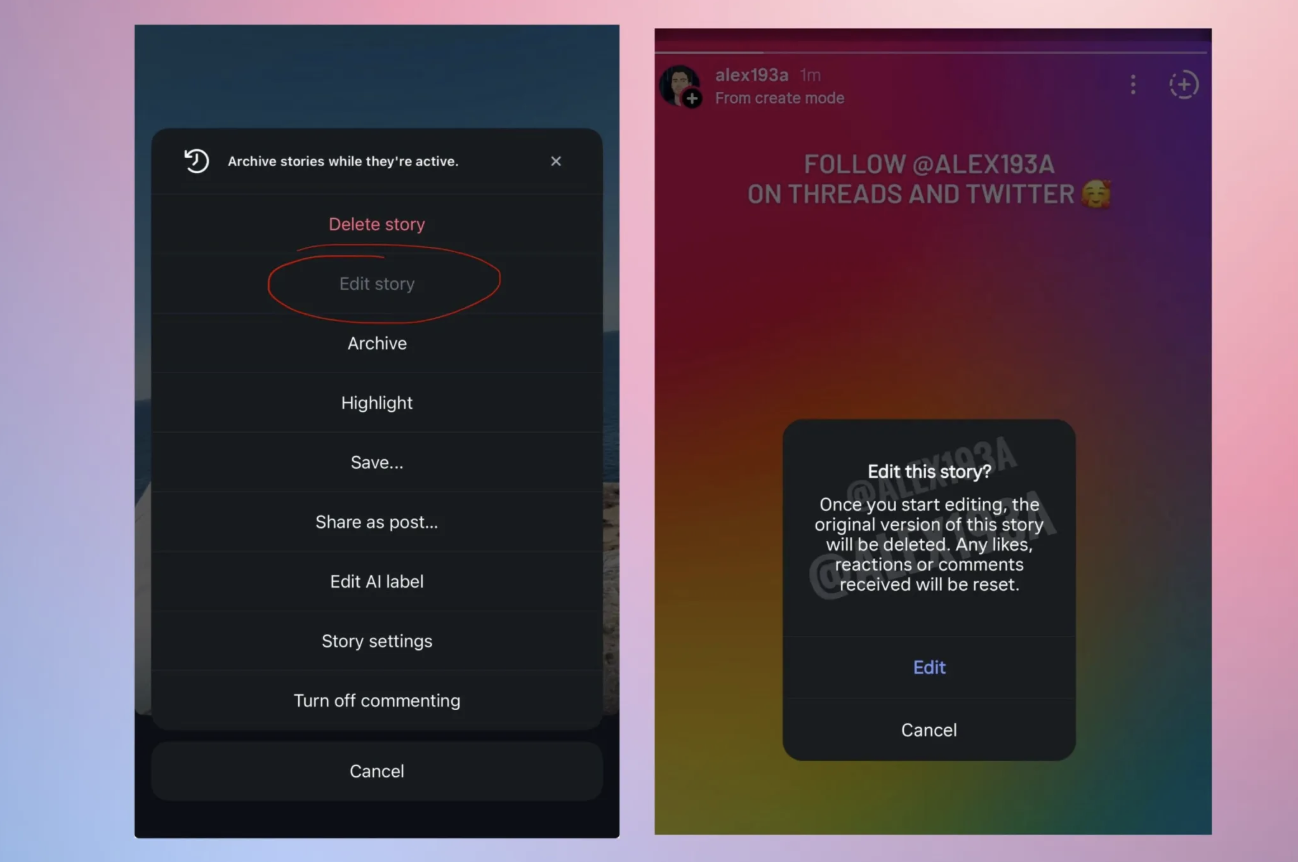
YOU CAN NOW EDIT STORIES
Instagram is testing a feature that lets you change a Story after you’ve posted it, instead of deleting and reposting. You reopen a published Story and edit it, and the app shows a warning: “Once you start editing, the original version of this story will be deleted.” It was first spotted by social media consultant Matt Navarra, with early access limited to some iOS users. Instagram hasn’t formally announced it, and it hasn’t said what you can edit (text, stickers, links, tags).
The catch is that editing replaces the original Story and resets its engagement. Likes, reactions and replies are cleared. So it’s a convenient fix for a typo or a wrong link, but it won’t rescue a Story that has already gathered a lot of interaction.