
NOW TRENDING: WALK WALK FLIP ENGAGE & “HE’S A 10 BUT HE…
WHAT’S ON THE FEED THIS WEEK?
PRETTY LITTLE LIARS “-A”
Pretty Little Liars' anonymous texter never left the group chat, at least not on TikTok. Creators write themselves a shady, slightly humiliating message, sign it "-A," and read it aloud over demi devito's "pll purposes only ty" sound while doing the exact embarrassing thing the text calls out. It's a self-drag dressed up as a threat, and the specificity is everything: creator Nia's version ("I saw you dim your brightness and check your account before checkout, you brokie -A") pulled 1.4 million likes, and even original cast member Shay Mitchell jumped on the sound. It resonates because it turns the universal experience of being perceived into a joke you tell on yourself, rewarding a sharp point of view over polish.
Brand opportunities
This is a gift for brands with a bit of self-awareness. Write the "-A" text as the thing your audience secretly does, or the thing your brand does, then get caught red-handed: a fashion label can do "I saw you add three things to cart just to hit free shipping -A," while a finance or tech brand can call out the little in-app habits users pretend they don't have. It also works brilliantly as founder or staff content, since a real face getting exposed reads as human rather than corporate. Keep the callout hyper-specific to your niche and let the caption carry the punchline.
WALK WALK FLIP ENGAGE
This one didn't start as a dance or a challenge; it started as a how-to. Creator @myfriendshells posted a video walking people through her formula for "making content," literally narrating the beats: walk, walk, flip, engage. It took off for two very different reasons. First, it's genuinely useful, a tidy, repeatable structure for shooting a confident piece to camera that anyone can copy. Second, and this is what really tipped it into virality, hearing content reduced to four robotic commands struck a lot of people as faintly dystopian, a peek at just how formulaic "authentic" social content has quietly become. So it's spreading as both a legitimate technique and a knowing joke about the technique, which is a rare and sticky combination.
Brand opportunities
You can play this one straight or winking, and both work. Played straight, it's a clean shooting formula for a product reveal or fit check: two strides in, a flip or outfit transition, then a beat of direct eye contact to close. Played winking, lean into the self-aware angle, let a founder or team member deadpan the "walk, walk, flip, engage" instructions while doing them, and quietly admit that yes, this is exactly how the sausage gets made. That second approach is the smarter play for most brands right now, because it rides the dystopian-humour wave everyone's actually sharing, and it signals you're in on the joke rather than earnestly chasing the trend. Keep it low-fi; polish is the enemy of this particular bit.
‘HE’S A 10 BUT HE…’ CARD GAME
The "he's a 10 but he…" debate format has had real staying power, and it's having another moment now that it's jumped off the feed and onto the coffee table. Physical party games built on the trend (What Do You Meme's "They're a 10 But…" and various spin-offs) are selling well, feeding a fresh wave of content where creators film themselves and their mates playing, rating an imaginary date's baseline hotness and then adjusting for a wildly specific trait card. It works because it's engineered for disagreement: the rating format forces a reaction, comment sections fill with people arguing over dealbreakers versus green flags, and the in-real-life game version adds a warm, social, "tag who you'd play this with" layer on top.
Brand opportunities
Make your own deck of "10 but…" cards using traits from your world: a travel brand can run "it's a 10 but the flight's at 5am," while a hospitality or food brand can rate dishes, venues or dating-at-your-venue scenarios. Post it as a fill-in-the-blank and explicitly invite the audience to settle the debate in the comments, because that argument is where the reach comes from. A branded printable or physical card set is also a genuinely giftable, shareable asset that lives well beyond a single post.
ACCOUNT
FENTY X HUDA X GLOW RECIPE EYE PATCHES
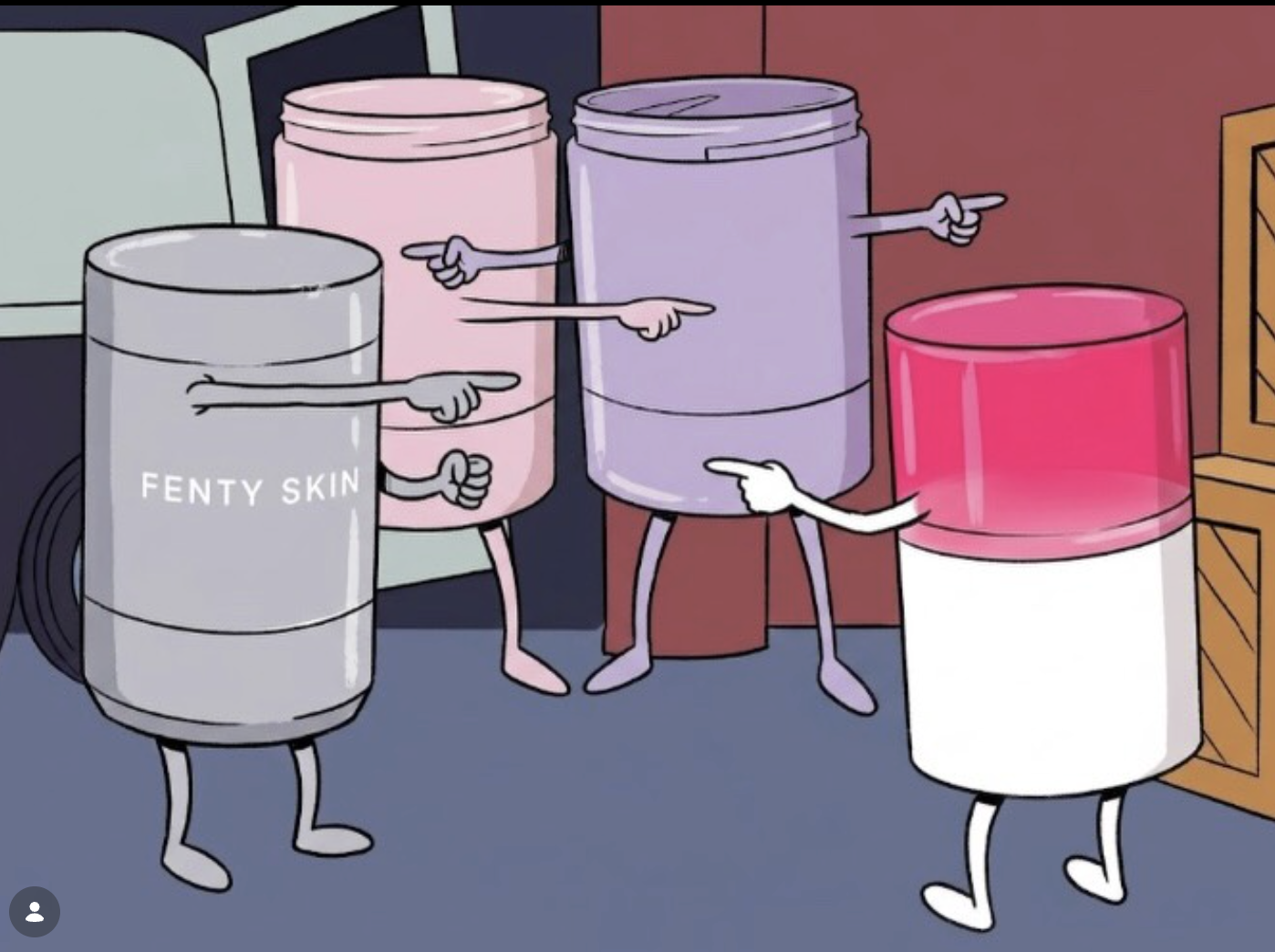
Fenty Skin launched its "first of its kind" fresh-sliced hydrogel eye patches on 17 September, and within days creators noticed Glow Recipe's new eye mask used the identical twist-and-dispense cylinder, followed by an unreleased Huda Beauty version in the same packaging. Three major brands, one suspiciously identical design, and the cause turned out to be mundane: as Huda Kattan put it, they'd all been "screwed over by the same packaging supplier" that sold each of them "exclusivity." Rather than lawyer up or go quiet, Fenty leaned into the joke with a "Spider-Man pointing at Spider-Man" meme captioned "Pulling up to the function with your hgs in the same fit," and rivals played along, with Huda Beauty replying "Great minds think alike." It worked because Fenty read the room instantly and chose warmth over defensiveness, turning a packaging fail into a wave of free, positive coverage.
Brand opportunities
The lesson is that when something goes sideways in a way that's more funny than harmful, self-deprecation beats spin every time; being first to make the joke defuses it and makes you look confident rather than rattled. The reactive nature of the content landed really well with its audience because it was making fun of itself. The fact this was collab posted with Fenty and Huda beauty knows they can make this tongue in cheek. It also pays to watch what your "competitors" are doing, because a shared, good-natured moment between brands reads as authentic and gets both sides talking to each other's audiences. Prepare for it by agreeing in advance who can sign off on a cheeky reactive post in minutes, because these windows close fast.
SOCIAL UPDATES
ADAM MOSSERI REVEALS THE INSTAGRAM ALGORITHM
LINK
Instagram head Adam Mosseri has been on a run of videos demystifying how the platform ranks content, and the headline is refreshingly concrete: the signals that matter most are watch time, sends per reach (how often people DM your post to a friend) and likes per reach, and they apply to both "connected" reach from your followers and "unconnected" reach from people who don't follow you yet. The signal he keeps stressing hardest is sends, not likes or comments or even watch time, but whether your content is good enough that someone privately fires it to a mate. He's also been clear that "raw," imperfect content outperforms glossy production, and reminded users they can shape their own feed with tools like Favourites, "Not interested," and topic controls.
Brand opportunities
Start designing posts to be sent, not just seen: ask "who would someone DM this to, and why," and build that in, whether it's the oddly specific relatable moment, the useful tip worth passing on, or the "this is so us" content a friend group shares internally. That instinct lines up perfectly with the trends above, since "-A" and "he's a 10 but…" are practically built to be forwarded and argued over. Take the "raw beats polished" note as permission to loosen up, because lower-fi content from a founder or team member is now backed by the platform's own guidance, making it a safe bet as well as a cheaper one.
Watch below:
